Search the Site

The Defensive Cross Country Seat (Current freebie!)

publication date: Mar 7, 2011
Download Print Send a summary of this page to someone via email.


The Defensive Cross Country Seat
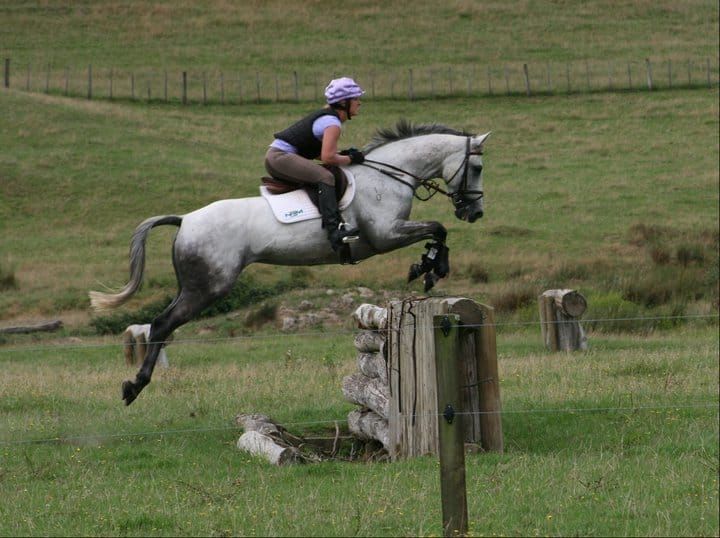


Cross country riders must have this seat in their repertoire. It becomes increasingly important as one moves up the levels, as the speed and jump dimensions increase.

This rider has intentionally put their center of gravity somewhat behind their base of support. It's a defensive or safety position that many riders adopt at times on cross country, to ensure safety at speed when the ground drops away, or the terrain makes it likely for the horse bobble on landing.


The difference between this picture and simply "getting left behind" is that this rider is still giving the horse complete freedom, and upon landing will be right back with the motion. That is part of the art of cross country riding - developing the ability to put yourself a bit behind the motion when necessary, while not interfering with the horse in any way.

How does one develop this position? It must be practiced! Get in a balanced two point position, and shift your hips back, pushing your feet slightly out in front of you. Get comfortable in this position in all three gaits, and then test youself by trotting and cantering downhill in this position. You will probably have to fight the instinct to "sit up" going down the hill. But you will find that in this defensive two point position, where your center of gravity is further back in the saddle, you will feel even more secure trotting and cantering down hills vs leaning back and bringing your hips (and your center of gravity) forward. Most importantly, you are slightly off of the horse's back, which allows the horse to use his back more freely. And in keeping your angles (which when you lose when you lean back), your shock absorbers work to allow you to smoothly follow the horse's motion.

Once you are comfortable cantering down hills in this position, you are ready to use it on cross country. Anytime you are going downhill, or are jumping a fence with a drop landing or uneven, rough ground on the landing is a good time to adopt this position. If your horse stumbles, you will be safely behind the shoulder. 

It also comes in handy to use in front of fences when riding horses that may want to stop. As it keeps more of the horse in front of your leg, and makes it easier for the rider to use seat and leg to drive the horse foward.

You will need to consciously think about using this position when tackling a cross country course at first. But it eventually becomes an instinctive thing, that you don't even need to think about. When your horse makes an awkward jump, or when you are negotiating uneven difficult terrain, being able to quickly get into this position will keep you safe, and will help your horse to recover his balance more easily.


2 Comments Posted Leave a comment

Laura Szeremi (Killeen)
Lesley Stevenson (Charlotte)
 

Add a comment:

Sign in to comment on this entry. (Required)
